
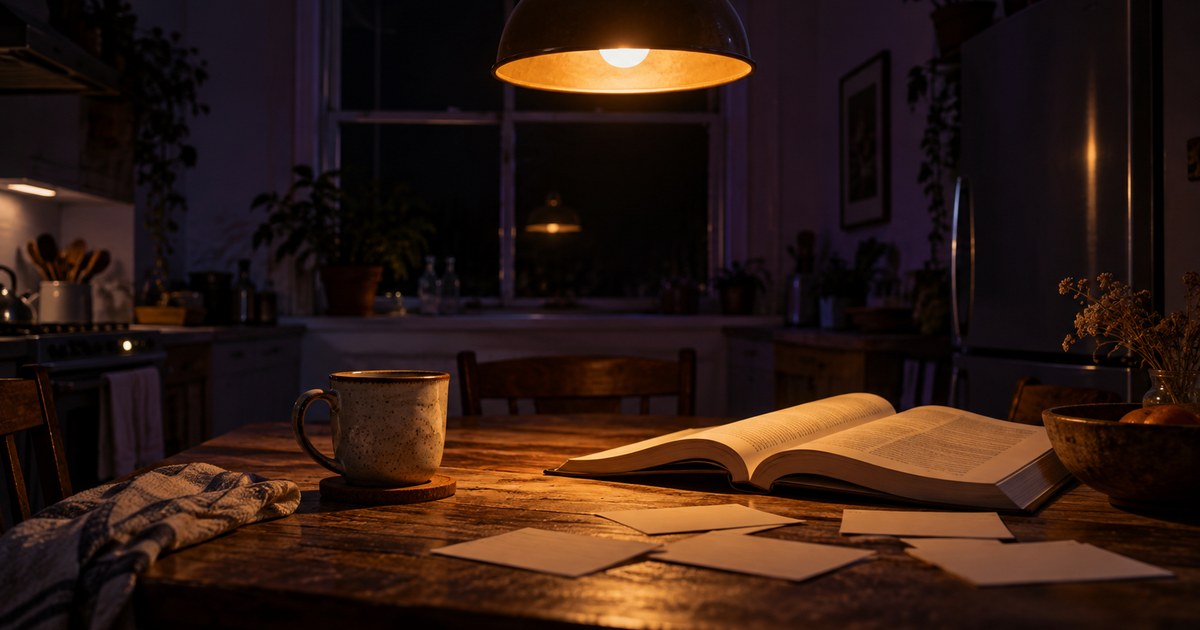
Change what you are doing before you change what you are drinking, because an active task is harder to drift out of than a passive one. That part is reasoning rather than a measured finding. What is measured is the cost of the caffeine, and the timing is the part every list skips.
The standard page on this subject is a list: coffee, cold water, get up and walk, chew gum, sit somewhere uncomfortable. Most of it is fine. What is missing is any account of the trade you are making, which is the only thing that separates a useful late session from a night that takes two days to pay for.
Why does reading put you to sleep?
Because it asks almost nothing of you.
Rereading a chapter is a low-demand activity that produces a strong feeling of familiarity, which is easy to read as progress. It is comfortable and it is passive, and comfortable passive activities are not the ones you stay alert through. No study cited here measured drowsiness while rereading, so take that as reasoning. The fix it points to is making the task itself demand something rather than adding stimulation from outside.
Roediger and Karpicke demonstrated the learning half of this in 2006. Students studied prose passages and then either took recall tests with no feedback or restudied the passages the same number of times, before a final test after 5 minutes, 2 days or a week. On the 5 minute test, restudying won. At 2 days and a week, the students who had been tested retained substantially more, even though the restudying group felt more confident about how well they knew the material.
Note what that study did and did not measure. It measured retention, not alertness. Nobody has tested whether retrieval practice keeps you awake, so the connection this post is drawing is an inference: rereading feels productive and is comfortable enough to doze through, while closing the book and trying to reproduce the argument is not comfortable at all. What the evidence does establish is that the uncomfortable version is the one that holds up days later. The active recall guide covers how to run it properly.
What does caffeine actually cost?
More of tomorrow than people budget for.
Start with the pharmacology. The Sleep Foundation puts caffeine’s half-life at roughly 2 to 12 hours across individuals, with most people clearing half of a dose in about 4 to 6 hours, and full clearance taking considerably longer than a single half-life. The spread is genuine: genetics, pregnancy, smoking, oral contraceptives and certain medical conditions all move it. There is no single number, which is why any page giving you one is rounding.
Then the direct test. Drake, Roehrs, Shambroom and Roth gave 12 healthy normal sleepers 400 milligrams of caffeine, which the Sleep Foundation puts at roughly four cups of coffee, at 0, 3 or 6 hours before their usual bedtime, against placebo, and monitored sleep at home. All three timings produced statistically significant sleep disturbance compared with placebo. Six hours before bed still showed a measurable effect.
Twelve people and a fairly large dose is a small study, and it should be read as suggestive rather than as settled. What makes it worth citing is that the six hour cutoff was already standard sleep-hygiene advice with very little tested behind it, and this study is the one that went and tested it. Its finding is that even the cutoff was not clean. The Sleep Foundation’s own guidance is more conservative still, at eight hours.
The practical read is not “never drink coffee.” It is that a coffee at 10pm is a loan against a specific night, and you should take it knowing that. If the exam is tomorrow morning, the loan may be worth it. If the exam is in two weeks, it is not.
What does the missing sleep cost?
Enough to matter for the exact abilities you are staying up to use.
Lowe, Safati and Hall published a meta-analytic review in 2017 covering 61 studies across 71 populations. Sleep restriction produced an overall effect of g = -0.383 across cognitive domains. Broken down: sustained attention took the biggest hit at -0.409, executive functioning came in at -0.324, and long-term memory at -0.192. They found insufficient evidence for effects on multitasking, impulsive decision-making or intelligence measures specifically.
Sustained attention is the one to notice. It is the largest effect in the set and it is precisely the capacity that a long reading session runs on. Staying up to read is a trade where the thing you are spending is the thing you need.
None of this says a late session is never worth it. Deadlines are real and sometimes the only available hour is a bad one. It says the honest framing is a cost you have chosen, not a free extension.
What works better than pushing through?
A short nap, taken deliberately, with the caffeine before it rather than after.
Hayashi, Masuda and Hori tested this in 2003 with 10 young adults across five conditions in the early afternoon: a short nap alone, caffeine plus nap, nap plus bright light, nap plus face washing, and no nap. Caffeine combined with the nap was the most effective condition for both subjective sleepiness and performance, holding up across the full hour of testing afterward. The usual explanation for the order is that caffeine takes roughly the length of a short nap to come on, so you wake as it arrives. The study tested the combination rather than that mechanism, so treat the explanation as the reasoning it is.
Ten people is a very small study and it tested a mid-afternoon nap, not a 1am one. Nothing in it generalizes to napping close to bedtime, where you are simply borrowing from the night. Treat it as a good option for the afternoon slump and not as a strategy for 2am.
How to run the hour you have
Make the session short, defined and active.
Set a block with a stated end rather than working until you stop, because an open-ended session is the one you fall asleep inside. Twenty-five minutes is the standard unit and the 25 minute timer is the least ceremonious version of it. Inside the block, do something retrieval-shaped: close the book and write what you remember, work a problem, explain the section out loud. Between blocks, stand up and move, which costs nothing and does not come out of tomorrow.
Handle the sound deliberately rather than by default. If the house is loud, that is a masking problem with its own answer, which the post on background noise for studying works through. If the house is quiet, be aware that the same steady instrumental bed that helps at bedtime is not going to help you stay upright, and nothing in the research separates those two uses. The sound is not the part of this doing the work. Either way, keep it instrumental: anything with a voice is competing for the same processing the reading needs.
Pocket Lofi’s Focus station is built for this end of the night. It is instrumental, it loops without arriving anywhere, and the timer means the block finishes on its own rather than dissolving. Starting it before you sit down, along with deciding the finish time, is the whole setup.
When the answer is to stop
Sometimes it is, and no list wants to say so.
If you have read the same paragraph four times, you are not retaining it, and the meta-analysis above describes the general shape of why. Trading the next three hours for sleep and a focused morning hour is the move that follows from it, though no study has run that specific comparison and this is reasoning rather than a finding. The work you do while fighting to stay conscious is the work you will have to do again.
The deep work guide is about building sessions that do not get you into this position in the first place, which is the real fix and a slower one. For tonight, the useful version is smaller: shorten the block, make the task active, be deliberate about the caffeine, and know what you are spending.
Sources
- How Long Does It Take for Caffeine to Wear Off?, Sleep Foundation
- Caffeine Effects on Sleep Taken 0, 3, or 6 Hours before Going to Bed, Drake C, Roehrs T, Shambroom J, Roth T, Journal of Clinical Sleep Medicine, 2013
- The neurocognitive consequences of sleep restriction: A meta-analytic review, Lowe CJ, Safati A, Hall PA, Neuroscience and Biobehavioral Reviews, 2017
- Test-enhanced learning: taking memory tests improves long-term retention, Roediger HL, Karpicke JD, Psychological Science, 2006
- The alerting effects of caffeine, bright light and face washing after a short daytime nap, Hayashi M, Masuda A, Hori T, Clinical Neurophysiology, 2003